![Jean Snow [.net]](http://www.jeansnow.net/wp-content/uploads/2024/04/JS_logo_2025.png)
One thing that’s happened to me over the past few years is that I’ve pretty much stopped taking photos. Sure, the odd iPhone-to-Twitter shot is still a regular occurrence, but in terms of taking photos with a relatively descent point-and-shoot — in my case, a series of Canon PowerShots — either for this site, for other sites, or even just for personal use, that just kinda stopped. You’ll notice it also if you check my Flickr account — except for a little rekindling courtesy of an iPhone/Toy Camera fling last year in Macau, not much has gone up over the past couple of years, to the point where I haven’t even renewed my pro account in years, and this coming from someone who was particularly active there.
So why? That’s a good question, and there are several answers to it. One thing is that I grew dissatisfied with the quality of what I was taking and sharing, but lacked the energy (and money) to move up to decent gear and shoot (yeah, pun sadly intended) for more. It also doesn’t help when you have a lot of friends who are so damn talented when it comes to photography — some would say this can be inspirational, but I’m on the side that tends to think, oh well, better leave this to those who are better at it.
But to be honest, the biggest reason is one that actually affected a lot of the content that you saw appear on this blog, and that’s even pre-SNOW Magazine. It got to a point where I just couldn’t “experience” anything for myself anymore. Every time I was out and about and spotted something interesting, I was immediately composing a blog post in my head about it (even if I had absolutely no intention of writing one) and taking photos to “document” it. This ended up literally getting in the way of my enjoyment of things. Many are sure to say that this is a handy skill to have, and I wouldn’t disagree, but it can also be a negative in the sense that I started losing something rather important, and that’s the pure sense of enjoying the moment/space you occupy.
Sure, this wasn’t just about photography, but I think one way to fix this for me was to remove that part from the equation. And you know what, after a while it did in fact work. I no longer cared which angle of what I was seeing or experiencing would best tell the story.
“OK, Jean, but this post is titled ‘Panasonic Lumix G2,’ no?”
Yes, how perceptive of you.
My wife has been wanting a decent camera for a while now, at first mostly to use for her next field research trip to China, but also to just start taking better photos of the things around her, including of course our dog. She finally pulled the trigger on a purchase yesterday and ended up getting the aforementioned Panasonic Lumix G2, the follow-up to the company’s G1, the camera that kicked off the whole “Micro System” craze. For months I’d been suggesting to her the GF1, in part because of Craig Mod’s amazing field test article, but also because at least 5-6 of my friends ended up buying one, to great satisfaction. She was able to get something a bit better — the GF1 is sort of a paired-down more compact version of the G2 (or rather its predecessor, the G1).
So this means we have a nice new camera in the house, and she says I’ll be able to use it when I want — although there seems to be some sort of unwritten rule stating that such sharing will happen after a fixed amount of time. The prospect of learning photography has me rather excited, and despite my fears of getting back to that sense of always being in reporter mode, I’m thinking that it will help get some more original (not reblogged) content on SNOW Magazine.
To be fair, I also have a feeling that the iPhone 4 is going to help with that. I finally got around to ordering one yesterday — the wait will take up to a month though — and from the examples I saw in this Boing Boing post, I think it will make for a great device when you’re in a pinch. But more than just the camera, it’s the prospect of HD video recording that has me excited, and I’m hoping that you’ll see the results on SNOW as well — and hey, that G2 takes some pretty decent HD videos too, just look at what Craig was able to get out of his GF1.
Next up is moving to some more serious photo editing tools — iPhoto and quick Photoshop touch-ups have been fine so far, but I want to move up. After asking about Adobe Lightroom versus Apple Aperture on Twitter, the feedback was overwhelmingly pro-Lightroom, and Adobe certainly makes it easy for you to try it out for yourself. It seems that Lightroom 3 was actually released just recently, so looks like I’m hopping on at a good time.
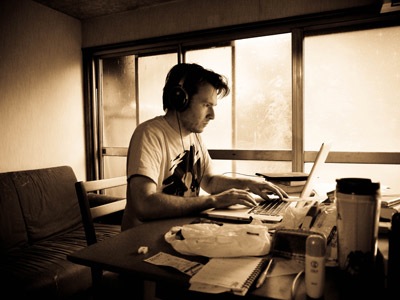
What you see at the top of this post is just me having fun with some of the filters in Lightroom, on a photo my wife took of me this morning — this is pretty much what I look like, and where I find myself, everyday. Funny how adding a vignette/sepia filter makes everything look oh-so serious. Looking at the photo, I really feel like a hard-working writer. Yeah.