Jean, I love Keiji’s stuff. Do you know if he’s selling it yet? Site is great as always. So much coolness.
I’m not quite sure if the chair is sold. Best thing would be to get in touch with Keiji.
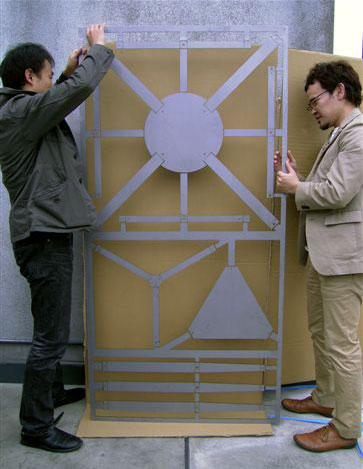
I think there is too much material wasted - he immitated plastic kit models with “runners” which are needed to inject-mould plastic models. His chair - more than sixty per cent of steel sheet is wasted: the runner and the punched sheet metal pieces. He needs to design a chair which utilises 100 per cent of the metal not juts the bits he wanted. Apart from reduced transportation cost it’s a reverse move to the current environmental designs.
But don’t the “runners” here act as support for all the pieces (to keep them together and protected)?
Jean,Thanks for posting this project as always!
Josh,I deeply understand what you mean.But recently we can sell iron scraps in Japan.That’s why many thieves steal
irons like an electric wire or stainless products here.
Also I don’t paint anything this product so It’s quite easy to recycle.
I mean you just put the iron scraps which were left in a recycling box of canned steel.
Thanks,Jean.
I will sell these products finaly.
This flat packing chair is 59800yen.
I don’t know it’s expensive or not.
Because these are build-to-order manufacturing so far,it’s a little expencive.
If I can make more than ten products,
it’s much cheeper.
Jean Snow is a daily contributor to Wired magazine's game blog, Game|Life, covering game news from Japan and beyond.
Tokyolife: Art and Design covers Tokyo's cultural output of the past few years, covering the works of over 80 influential creatives. Jean Snow provided coordination assistance.
The Superfuture Superguides are a series of PDF travel guides to some of your favorites cities, updated monthly, and obsessively compiling the best places to shop, eat, and drink. The Tokyo guide is edited by Jean Snow.
He is also the design/culture editor at Neojaponisme, a web journal covering social and cultural aspects of Japan. Read the manifesto, by founder and chief editor W. David Marx, here.
PauseTalk is a regular series of events that take place at Cafe Pause on the first Monday of every month, with a start time of 20:00. The idea is to create a forum where Tokyo-based creatives can get together and discuss their own projects, as well as cultural currents of the city. The next edition happens August 4 (there is no July edition).
Jean, I love Keiji’s stuff. Do you know if he’s selling it yet? Site is great as always. So much coolness.
I’m not quite sure if the chair is sold. Best thing would be to get in touch with Keiji.
I think there is too much material wasted - he immitated plastic kit models with “runners” which are needed to inject-mould plastic models. His chair - more than sixty per cent of steel sheet is wasted: the runner and the punched sheet metal pieces. He needs to design a chair which utilises 100 per cent of the metal not juts the bits he wanted. Apart from reduced transportation cost it’s a reverse move to the current environmental designs.
But don’t the “runners” here act as support for all the pieces (to keep them together and protected)?
Jean,Thanks for posting this project as always!
Josh,I deeply understand what you mean.But recently we can sell iron scraps in Japan.That’s why many thieves steal
irons like an electric wire or stainless products here.
Also I don’t paint anything this product so It’s quite easy to recycle.
I mean you just put the iron scraps which were left in a recycling box of canned steel.
But I also don’t like wasting materials.
I designed such a product that use almost all materials too.
If you have time,I am appriciated that you can check them.
http://www.keijidesign.com/flatpackingchair.html
http://www.keijidesign.com/flatpackingshelf9.html
http://www.keijidesign.com/flatpackingshelf.html
Keiji
Those are all quite nice, Keiji!
Thanks,Jean.
I will sell these products finaly.
This flat packing chair is 59800yen.
I don’t know it’s expensive or not.
Because these are build-to-order manufacturing so far,it’s a little expencive.
If I can make more than ten products,
it’s much cheeper.